
Agriculture depends on reliable fertilizers to support food production. Organic fertilizers can support soil health, nutrient cycling, and long-term productivity, while synthetic, mined, organic, biological, and recovered-nutrient fertilizers all play important roles in helping growers meet crop needs.
At the same time, large volumes of organic residuals contain nitrogen and phosphorus that can move into rivers, lakes, and coastal waters if not captured and managed effectively. This creates a practical challenge for farms, communities, food systems, and industries: how can more nutrients be retained, recovered, and returned to productive use?
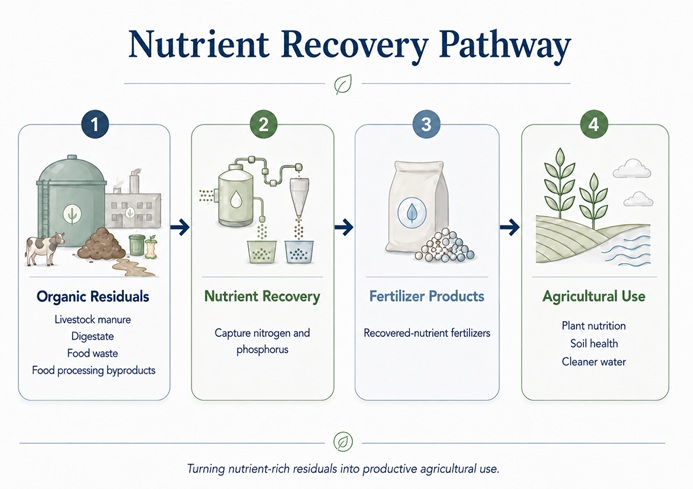
These nutrient-rich organic residuals can come from many sources, including livestock manure, anaerobic digesters, food waste, food processing byproducts, and other biological waste streams. For dairy farms, digesters, food processors, municipalities, and organic residual managers, the challenge is often not whether the material has value. The challenge is how to capture, concentrate, stabilize, and return those nutrients to productive agricultural use.
At GSR Solutions, we see recovered nutrients as one additional pathway that can help address this challenge. This perspective comes from our work at the intersection of nutrient recovery, fertilizer production, organic residual management, and grower access.
The Challenge: Nutrients in the Wrong Place
Nitrogen and phosphorus are essential for crop growth. In the right place, at the right rate, and at the right time, they support plant nutrition, yield, quality, and soil productivity.
But when excess nutrients leave farms, food systems, and other organic waste streams, they can contribute to water-quality problems. Nutrient runoff and discharge are major reasons why nutrient management remains a priority for regulators, producers, and communities.
This is not a question of whether agriculture needs fertilizer. It does. The question is how more nutrients already present in organic residuals can be captured and put back to work.
The Opportunity: Capture Nutrients and Return Them to Use
Organic residuals from farms, food systems, and biological processing streams often contain valuable nitrogen and phosphorus. When those nutrients are recovered, they can become part of the fertilizer supply instead of remaining a disposal or runoff challenge.
Recovered-nutrient fertilizers are not a replacement for every fertilizer source. They are an additional tool that can complement existing fertilizer systems, support nutrient stewardship, and create value from materials that are already available.
This approach can help connect three priorities:
- Plant nutrition
- Soil health
- Water quality
By recovering nutrients from organic residuals and converting them into usable fertilizer products, farms and communities can reduce nutrient-loss risks while giving growers another practical source of crop nutrients.
Where Existing Nutrient Management Solutions Fit
Nutrient recovery and nutrient management are not new. Composting, solids separation, land application of manure, digestate, and separated solids, struvite recovery, ammonia capture, filtration, concentration, and other approaches already play important roles in managing nutrient-rich residuals.
The practical challenge is matching the right approach to the right site and output pathway. A solution needs to fit the feedstock, operating environment, economics, regulatory requirements, and end use. It also needs to produce an output that can be handled, understood, and used in real agricultural markets.
That is why nutrient recovery should not be viewed only as a treatment step. The stronger opportunity is to connect recovery with fertilizer product development, nutrient stewardship, and grower access.
Why Fertilizer Form Matters
Recovering nutrients is only the first step. To be useful for growers, recovered nutrients need to be converted into fertilizer products that are consistent, understandable, and practical to use.
That means attention to product form, nutrient analysis, handling, application rates, labeling, validation, and market access. A
For this reason, the work is not only about waste management. It is also about fertilizer forms.
How GSR Connects Nutrient Recovery to Fertilizer Use
GSR Solutions focuses on a practical objective: capturing nitrogen and phosphorus from organic waste streams and converting those nutrients into fertilizer products that can return value to agriculture.
GSR’s technology is designed to enhance, not replace, existing food, agriculture, and energy operations that depend on organic feedstocks. This opportunity is especially relevant for anaerobic digesters, dairy and livestock operations, food processors, municipalities, and project developers working with organic feedstocks.
Recovered-nutrient pathways can also support anaerobic digestion projects that produce CHP electricity and heat or RNG by creating practical fertilizer outlets for digestate-derived nutrients.
For these operations, nutrient-rich residual streams such as livestock manure, anaerobic digestate, food waste, and food processing byproducts can create both nutrient-management pressure and value-creation opportunity. By capturing and converting nitrogen and phosphorus from these streams, GSR can help strengthen the connection between waste handling, energy production, fertilizer value, and agricultural use.
Through the NutriHarvest® partner platform, GSR helps connect recovered nutrient pathways with grower-facing fertilizer products.
A Complementary Path for the Fertilizer Sector
The fertilizer sector already includes many nutrient sources, technologies, and production methods. Recovered nutrients can add to that mix.
- They can help recover value from organic residuals.
- They can support nutrient stewardship.
- They can provide crop nutrients.
- They can help reduce nutrient losses to waterways.
- They can create new fertilizer products and market opportunities.
This is an additive opportunity, not a replacement argument.
As agriculture works to feed a growing population, effective fertilizers will remain essential. Recovered-nutrient fertilizers can help expand the range of available fertilizer solutions while also addressing the challenge of excess nutrients in the wrong place.
The Path Forward
The nutrient runoff challenge and the fertilizer supply challenge are connected, but they do not need to be treated as opposing issues.
Agriculture needs dependable fertilizers. Water bodies need fewer excess nutrients. Organic residuals contain nutrients that can be captured and returned to productive use.
GSR Solutions is focused on that practical middle ground: recovering nutrients from organic waste streams, converting them into fertilizer products, and helping growers access them through NutriHarvest.
“When nitrogen and phosphorus in residuals leave productive use, value is lost and water resources are put at risk. The practical opportunity is to recover those nutrients and return them to agriculture for crop nutrition, healthier soils, and cleaner water.”
— Anju Krivov, Founder & CEO, GSR Solutions
For inquiries related to nutrient recovery, fertilizer production pathways, or organic residual management, contact GSR Solutions.
Contact GSR Solutions